
Fulton County Court Records After Arrest
The Fulton County arrest-to-court path is clear because the county says the Centralized Arraignment Part is maintained at the correctional facility. Police agencies lodge arrested people at the Fulton County Correctional Facility for later arraignment, especially after hours. A group of judges conducts CAP arraignments for the entire county. After arraignment, the case moves to the proper town court, city court, Fulton County Court, or another assigned court depending on charge level and procedure.
Court records after a jail arrest should not be confused with Fulton County jail inmate records. A custody search asks whether someone is held. A court-record search asks what case exists, what charges were filed, what appearance is next, and how each charge stands. Booking allegations can be amended, reduced, dismissed, or superseded after prosecutor review.
Arrest to Fulton County Court Records
The path usually runs from arrest to booking, then arraignment, then prosecutor review. The Fulton County District Attorney's Office prosecutes all crimes in the county, including cases in 10 town courts, 2 city courts, and County Court. The DA page lists Michael J. Poulin as District Attorney and describes the office's work with local, state, and federal police agencies in prosecution.
- An arrest is made by the Sheriff's Office, city police, State Police, or another agency.
- The arrested person may be lodged at Fulton County Correctional Facility.
- CAP or another court handles arraignment, release, bail, non-monetary conditions, or remand.
- The District Attorney reviews and prosecutes charges in the proper court.
- The case becomes trackable through WebCriminal, a court clerk, or CHRS when applicable.
Find Fulton County Court Records Online
NY Courts WebCriminal is the official criminal-case search tool identified in the research. It is for case and calendar information, not jail custody. Use it after arraignment or once a case is opened. If a person was just arrested and no case appears, custody may still need to be checked through VINELink or the jail phone while the court record is created.
The New York WebCriminal page shows the official search modes available for criminal case lookup.
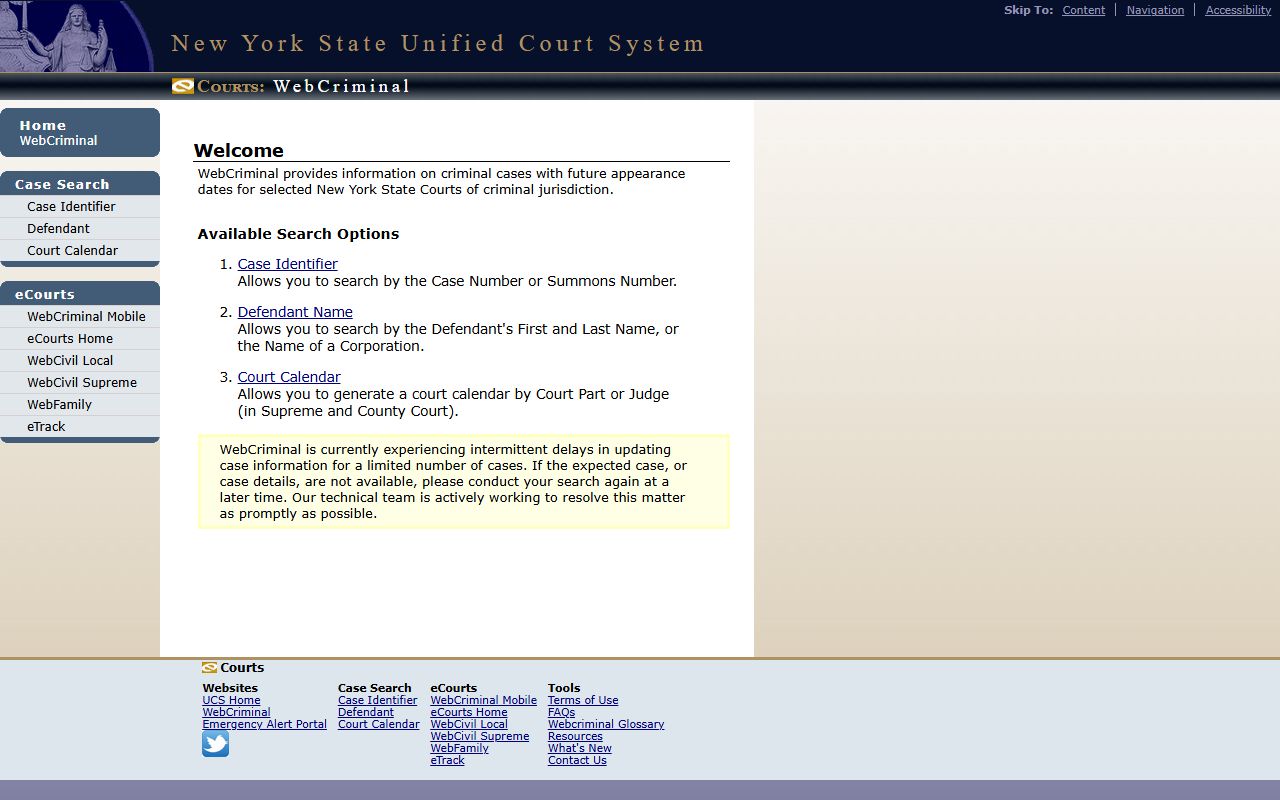
The portal is the right place to look for case identifiers, defendant-name searches, and court calendars after Fulton County jail booking moves into court processing.
| WebCriminal mode | Use | Limit |
|---|---|---|
| Case Identifier | Search when a case, docket, or summons identifier is known. | Requires the right identifier. |
| Defendant | Name-based search for a criminal case. | Case details require interactive portal use. |
| Court Calendar | Find matters by court and date calendar. | Does not confirm jail custody. |
Fulton County Charging Documents
Court records after an arrest are built from charging documents, not from the jail's intake note alone. A complaint may start the case. An information may become the formal accusatory instrument in many non-indictment prosecutions. An indictment is a grand-jury charging document, commonly tied to felony prosecution in County Court. The charge record can change as prosecutors review evidence and courts rule on the case.
| Document | What it does | Common use |
|---|---|---|
| Complaint | Initial accusatory paper used to start many criminal cases. | Early local criminal process after arrest. |
| Information | Formal charging document used after conversion or prosecutor review. | Many misdemeanor and non-indictment matters. |
| Indictment | Grand-jury charge that can supersede earlier paperwork. | Felony prosecution in County Court. |
Charge Status After Fulton County Arrest
A charge is an accusation until it is resolved by plea, trial, dismissal, or another court action. Court records after jail arrest should be read by charge status, not by the fact of booking alone. A booking charge may differ from the charge the Fulton County District Attorney files, and an early charge may be amended or reduced. The current court record is the better source for case status than a custody notification screen.
| Status | Plain meaning | Why it matters |
|---|---|---|
| Pending | The charge or case has not been resolved. | Next court dates and release conditions may still change. |
| Amended or reduced | The original charge changed during prosecution. | The filed court charge may not match the booking allegation. |
| Dismissed | The charge or case ended without conviction. | Sealing may become relevant under New York law. |
| Conviction | A guilty plea or finding of guilt was entered. | Sentencing, jail, probation, or state prison consequences may follow. |
| Sealed | Public access is restricted by law. | Public portals and agency records may no longer show the case. |
Charges vs Convictions
A Fulton County arrest, a filed charge, and a conviction are three different things. An arrest means law enforcement took a person into custody. A charge means an accusation was filed or pursued in court. A conviction means guilt was established by plea or verdict. The distinction matters for public records, employment-screening limits, and how court records are read.
| Charge | Conviction | |
|---|---|---|
| Stage | Accusation in a pending or resolved case | Guilty plea, verdict, or finding |
| Proof level | Enough to proceed under criminal procedure | Established through plea or proof beyond a reasonable doubt |
| Record meaning | Does not prove guilt by itself | Reflects a resolved guilty outcome |
| Where checked | WebCriminal, court clerk, charging document | Court disposition, CHRS, official criminal-history channels |
Fulton County Bail and Remand
Release decisions after a Fulton County jail arrest are made by a court. CAP or a later court appearance may address release on recognizance, non-monetary conditions, cash bail, secured bond, partially secured bond, or remand. The jail holds the person under the court order. It does not create the bail amount. Family members should confirm any payment location, method, and hours with the court or jail because the corrections page did not publish a bail-payment counter schedule.
Record check: VINELink can help with custody status, but bail and court-date details should be verified through WebCriminal, the court clerk, or the jail phone when timing is urgent.
Fulton County CHRS Searches
NY Courts CHRS is different from WebCriminal. Criminal History Record Search is a statewide search based on exact name and date-of-birth matching, and the research source states the fee is $95. It can be submitted through online Direct Access or by mail. CHRS is not a free jail lookup, not a custody alert, and not a substitute for calling the jail about a new booking.
The NY Courts CHRS overview explains the statewide criminal-history search and fee.
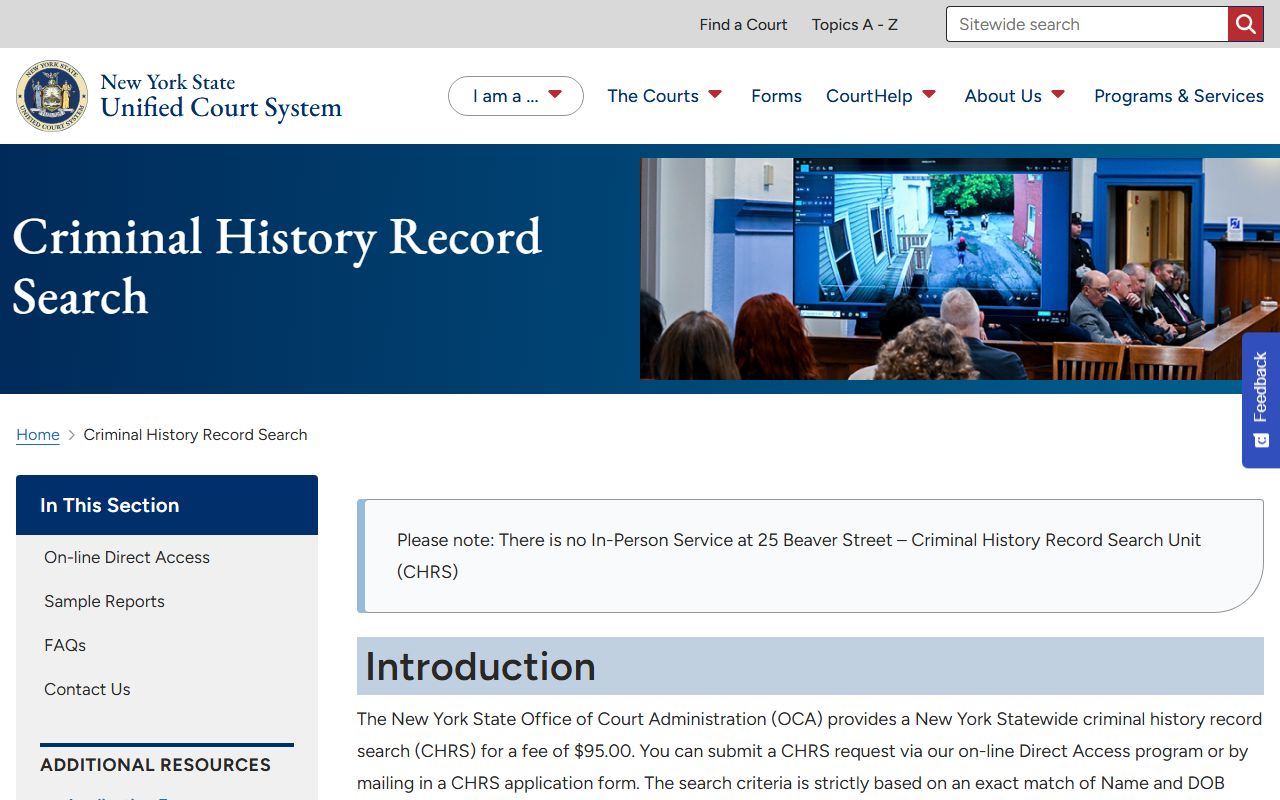
Use CHRS only for the statewide court-history function it provides, and verify any custody or bond question with the agency or court that controls the current case.
Warrants After Fulton County Arrest
No official Fulton County Sheriff's active-warrant search page was located. That means warrant questions should be routed through official channels. The Sheriff's Office main line is (518) 736-2100 for non-emergency questions, and emergencies go to 911. Johnstown Police, Gloversville Police, local courts, and the Sheriff's Civil Division may also be relevant depending on which agency or court created the record.
A warrant can lead to a jail booking when law enforcement executes it in Fulton County. Custody may then appear through VINELink, while the case or appearance may appear through WebCriminal or the court clerk. Bench warrants often come from a court after failure to appear. Search warrants and civil warrants are different records and should not be treated as jail roster items.
Sealed Fulton County Court Records
New York Criminal Procedure Law Section 160.50 restricts official records after a criminal action terminates in favor of the accused. Public Officers Law Section 87 also allows agencies to deny or redact records for listed exemptions. That means dismissed, sealed, youthful, juvenile, active-investigation, safety, or privacy-sensitive records may not be available to the public even when an arrest once occurred.
| Sealed | Expunged | |
|---|---|---|
| Meaning in New York context | Public access is restricted under a statute or court process. | New York materials more often discuss sealing than full deletion for these records. |
| Public portal effect | Records may disappear or be withheld. | Do not assume a public search will show it. |
| Who verifies | Court clerk, DCJS, or counsel. | Court clerk, DCJS, or counsel. |
Booking photos raise separate issues. The Fulton County jail mugshots page covers what was found about booking photos, FOIL, and sealed-record limits.